
What Does an Immigration Lawyer Actually Do? Services, Processes & Their Contribution in Successful Outcomes
Discover what UK immigration lawyers actually do, from visa applications to appeals, and when your case genuinely needs one, explained clearly for 2026.
WHAT YOU NEED TO KNOW
- •Immigration lawyers advise on and manage visa applications, settlement, sponsor licences, appeals and correspondence with the Home Office.
- •There is a real difference between a lawyer giving advice and a lawyer formally representing you, and knowing which one you are paying for matters.
- •Most cases follow a similar process: consultation, evidence gathering, submission, then Home Office correspondence through to a decision.
- •Lawyers can represent family visa applicants, businesses sponsoring workers and people applying for settlement or citizenship.
- •You do not legally need a lawyer for every application, but the more complex or high stakes the case, the more a lawyer's involvement tends to matter.
An immigration lawyer advises on and manages every stage of a UK visa or immigration case, from working out which route actually fits your circumstances through to preparing the application, gathering the right evidence and handling any correspondence with the Home Office or UK Visas and Immigration, known as UKVI. For more complex matters, that role extends further still, into appeals, tribunal representation and sponsor licence compliance work that a general adviser typically cannot take on.
That is the short version. Below, we break down the actual day to day work involved, how advice differs from representation, what the process looks like from first contact to decision, and where a lawyer's involvement tends to matter most.
What Services Does an Immigration Lawyer Provide?
The scope of work is broader than most people expect going in. A UK immigration lawyer typically handles:
- •Visa applications, including family visas, work visas such as the Skilled Worker route, student visas and visitor visas
- •Settlement applications, including Indefinite Leave to Remain and the various routes that lead up to it
- •British citizenship and naturalisation applications
- •Sponsor licence applications and compliance, for businesses hiring overseas workers
- •Appeals and administrative review, where an application has been refused and needs to be challenged
- •Human rights based applications, which follow a different legal test to standard visa routes
A good lawyer does not just fill in forms. They assess whether you actually meet the requirements before you apply, spot weaknesses in your evidence early and structure the application in a way that anticipates how a Home Office caseworker will read it.
Advice vs Representation: The Two Different Types of Help a Lawyer Gives You
This distinction rarely gets explained clearly, but it genuinely changes what you are paying for.
Advice means a lawyer reviews your circumstances and tells you what your options are, what evidence you need and what risks exist in your case. You then act on that advice yourself, or the lawyer prepares the paperwork but you remain the applicant of record throughout.
Representation goes further. The lawyer formally acts on your behalf, communicates directly with the Home Office as your representative and, where needed, appears for you at the tribunal if a decision is appealed. This matters most once a case moves past a standard application, particularly at appeal stage, where having someone qualified to argue your case in front of a judge is a meaningfully different service to someone simply advising you beforehand.
Knowing which one you are being offered, and which one your case actually needs, is worth clarifying at the very first conversation.
What Happens When You Work With an Immigration Lawyer: The Process Step by Step
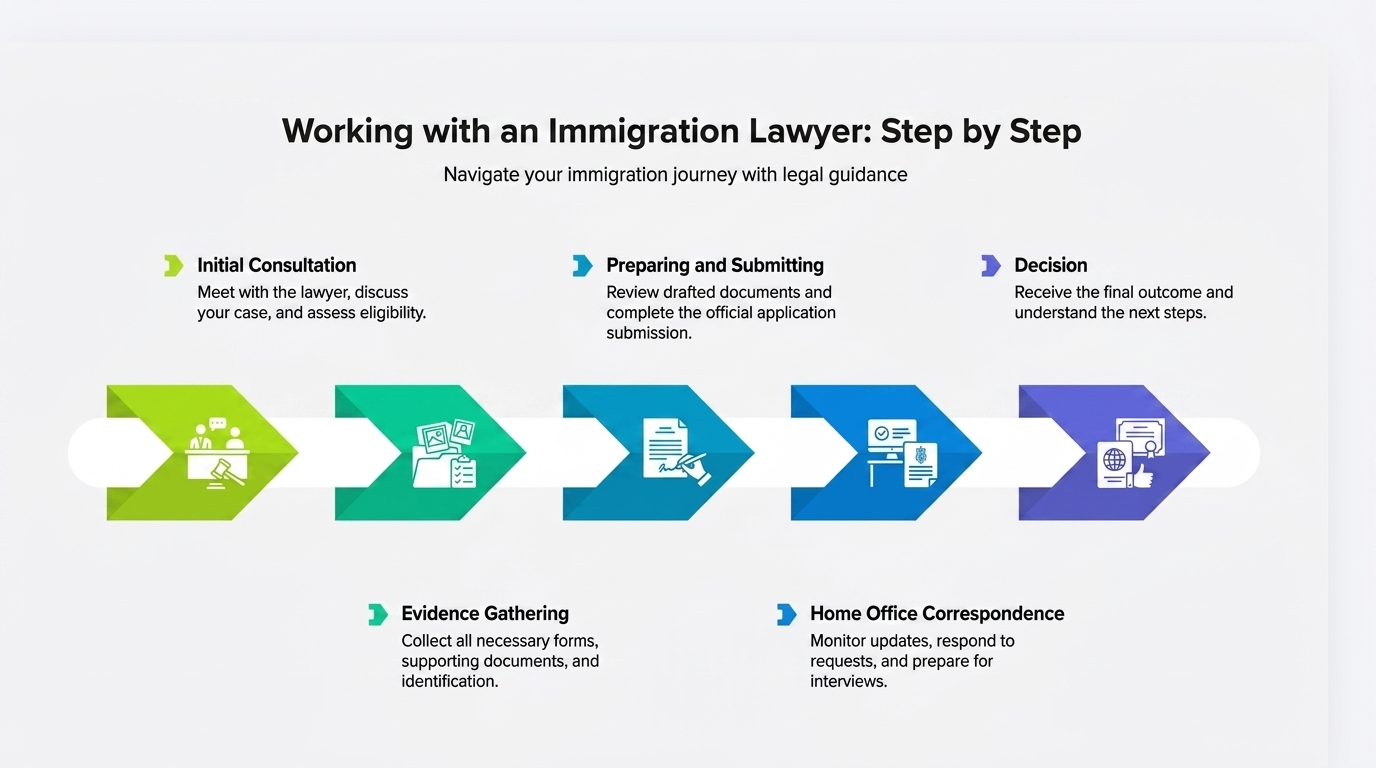
The process is fairly consistent across most UK immigration cases, though the depth of each stage depends on complexity.
- •Initial consultation. The lawyer reviews your circumstances, confirms which visa route applies, and flags anything likely to cause a problem, such as a previous refusal or a gap in your immigration history.
- •Evidence gathering. You are given a clear list of what is needed, financial evidence, relationship evidence, employment documents and the lawyer reviews everything before it is submitted, rather than after.
- •Preparing and submitting the application. The lawyer drafts supporting statements, organises documents and submits the application through the correct Home Office or UKVI channel.
- •Home Office correspondence. If the Home Office requests further information or clarification during processing, which happens more often than people expect, the lawyer handles that correspondence directly.
- •Decision. Once a decision is made, the lawyer explains what it means practically, whether that is a visa grant, a request for more evidence, or, in some cases, a refusal that needs to be challenged.
If something goes wrong mid case, a change in circumstances, an unexpected delay past standard processing times or a request for further evidence, this is exactly where having a lawyer already involved tends to pay off, since they can respond quickly rather than you working out what to do from scratch under time pressure.
Family, Business, and Settlement Cases: Where the Work Differs
Family and partner visas are heavily evidence based. A lawyer's main value here is making sure financial and relationship evidence is presented the way the Home Office expects to see it, since genuine relationships get refused surprisingly often simply because the paperwork was unclear or incomplete.
For people comparing local legal support, our guide to the best immigration law firms in Bristol can provide useful context when researching firms and considering what experience may be relevant to your particular immigration matter.
Sponsor licences and Skilled Worker visas involve a different kind of work entirely. Lawyers help businesses apply for a sponsor licence, set up the compliance systems the Home Office requires and manage individual Certificate of Sponsorship applications for each worker. Mistakes here can affect a company's ability to sponsor anyone at all, which is why this area tends to justify professional involvement even when a business feels confident handling paperwork itself.
For businesses comparing local legal support, our guide to the best immigration law firms in Birmingham can also help when assessing firms with experience in business immigration and sponsorship.
Settlement and citizenship applications carry their own risk, since a small technical issue, such as an unexplained absence from the UK, can derail an application built on years of otherwise solid residence. A lawyer reviewing the full history before submission catches most of these issues before they become a problem.
Do You Legally Need an Immigration Lawyer?
No, not for every application. Straightforward cases with no history of refusal can often be handled without one, sometimes with the help of a lower level, IAA authorised adviser instead.
Where a lawyer becomes genuinely worthwhile is once complexity enters the picture, a previous refusal, sponsorship, an appeal, or simply high personal stakes tied to the outcome.
How Much Does an Immigration Lawyer Cost?
Fees vary by case type and complexity, generally ranging from a few hundred pounds for a straightforward consultation up to several thousand for more involved matters like sponsor licence applications or appeals. For a full breakdown by visa type, including current gov.uk fees alongside typical legal costs, see our complete guide to UK immigration lawyer fees.
Final Thoughts
The value of an immigration lawyer is not really in filling out a form correctly, it is in knowing what a caseworker is actually looking for, catching a weak point in your evidence before it becomes a refusal and being ready to step in properly if something goes wrong partway through. For a straightforward case, that might mean very little hands-on work. For a complex one, it can be the entire difference between an approval and a refusal that takes months to put right.
When researching your options, our guide to the best immigration law firms in the UK can also help you understand the factors worth considering when comparing immigration lawyers and law firms.
Frequently Asked Questions
Can an immigration lawyer guarantee my visa will be approved?
No. The final decision always sits with the Home Office or UKVI, not the lawyer. Any lawyer promising a guaranteed outcome should be treated with caution.
Do I need a lawyer for a straightforward visa application?
Not necessarily. Simple, low risk applications with no prior refusal can often be handled independently or with a lower level regulated adviser. Complexity is what usually tips the balance toward needing a lawyer.
Can an immigration lawyer help after a visa has already been refused?
Yes. This is one of the areas where a lawyer's involvement matters most, since they can review the reasons for refusal and advise on whether an appeal, administrative review, or fresh application is the right route forward.
What is the difference between an immigration lawyer and a solicitor?
In the UK, immigration lawyer generally refers to a solicitor who specialises in immigration law, regulated by the Solicitors Regulation Authority. Both terms describe the same qualified, regulated professional.
We Cover the United Kingdom and Nearby Areas
Need Professional Assistance with Your Visa?
Navigating UK immigration rules can be complex and challenging. Get in touch with Westbury Law for professional legal services tailored to your specific case. Learn more about our immigration expertise or contact us directly.
Arrange a Consultation (£50 / 30 mins)