Made a Mistake on Your UK Visa Application? What to Do Next
Learn which UK visa application mistakes are minor or serious, how to correct errors after submission, and when to contact UKVI, withdraw or reapply.
WHAT YOU NEED TO KNOW
- Not every mistake is treated as deception.
- A submitted UK visa application usually cannot simply be reopened and edited online. If you need to change information after submission, you should contact UKVI and follow the process applicable to your application.
- The correct response depends on the type of error, the application stage and its effect on eligibility.
- Errors involving finances, previous refusals, criminal convictions, immigration history or false documents require particular care.
- Withdrawing an in-country application may affect immigration status, including section 3C leave in relevant cases.
Small mistakes can occur in even carefully prepared UK visa applications. These may include a misspelled name, incorrect travel date, missing refusal or financial information that does not match the supporting documents.
The consequences depend on the nature of the error. A minor typographical mistake may be harmless, while an incorrect financial figure or undisclosed immigration history may affect the application’s credibility, eligibility or suitability.
If you discover a mistake, ask:
- What information is incorrect?
- Has the application been submitted or biometrics completed?
- Does the error affect identity, eligibility, suitability or immigration status?
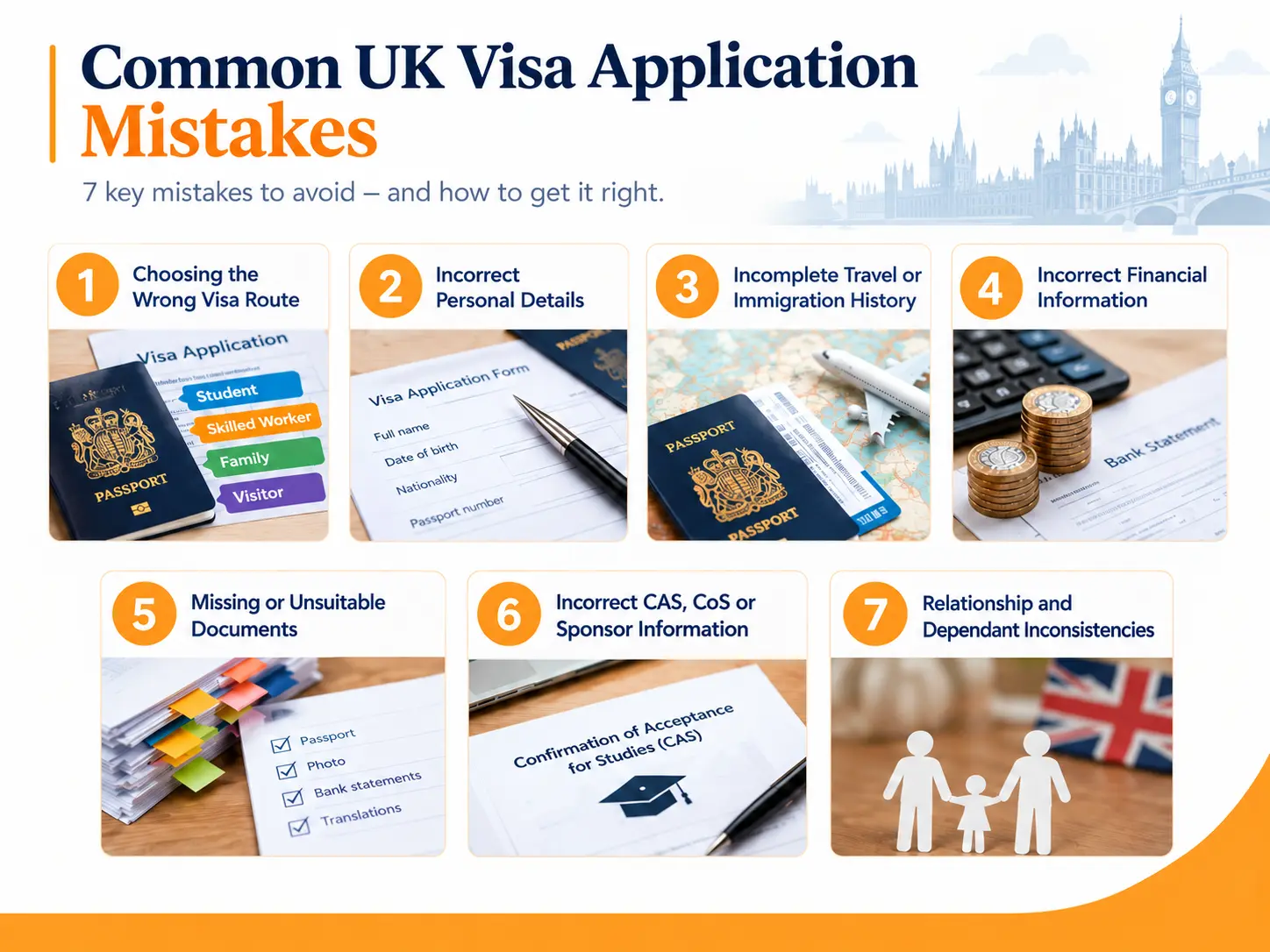
Common UK Visa Application Mistakes
Choosing the Wrong Visa Route
Each UK visa route has different requirements. Applying under the wrong category may mean that you provide the wrong evidence or fail to meet the relevant rules.
For example, Student, Skilled Worker, Family and Standard Visitor applications have different requirements for finance, sponsorship, English language, relationships and supporting documents.
What to do: Check the correct GOV.UK route before submission. If an application under the wrong route has already been submitted, do not automatically withdraw the application. First consider whether variation, withdrawal or a fresh application is appropriate and what effect the chosen option could have on your immigration status. Our team can help you review the correct visa route options for your circumstances.
Incorrect Personal Details
Common errors include:
- Misspelled name.
- Incorrect passport number.
- Wrong date of birth.
- Incorrect nationality.
- Missing previous name.
- Incorrect passport expiry date.
A minor typographical error may be low risk, but identity information should always match the passport.
Incomplete Travel or Immigration History
Depending on the application form and visa route, applicants may need to provide information about:
- Short trips.
- Travel on an old passport.
- Previous UK applications.
- Visa refusals.
- Overstaying or other immigration breaches.
Do not guess dates. Check old passports, decision letters, travel records and emails where available.
Incorrect Financial Information
Financial mistakes may involve:
- Income that does not match payslips.
- Bank statements covering the wrong period.
- Insufficient funds.
- Unexplained deposits.
- Incorrect exchange-rate calculations.
- Evidence belonging to the wrong person.
Financial requirements differ between routes. Correcting a figure may reveal that the applicant does not meet the relevant requirement, so this is not always a simple administrative issue.
Missing or Unsuitable Documents
Problems may arise where documents are:
- Missing.
- Illegible.
- Uploaded in the wrong category.
- Untranslated where a translation is required.
- Outside the relevant date range.
- Inconsistent with the application form.
Always follow the document requirements for the specific visa route.
Missing evidence does not automatically mean that an application will be refused. In some circumstances, Home Office evidential flexibility guidance allows a decision-maker to request further information or evidence. However, applicants should not rely on this. The rules differ between routes, and UKVI does not have to request further evidence where it would not change the outcome.
Incorrect CAS, CoS or Sponsor Information
Students and sponsored workers should check:
If you are a student, see our UK Student Visa guidance. If you are a sponsored worker, see our Skilled Worker Visa guidance.
- Name and passport details.
- Course or employment dates.
- Salary.
- Job title.
- Occupation code.
- Sponsor information.
The application form should match the CAS, CoS or other sponsorship record. If the sponsor or institution made an error, ask them to verify and correct the underlying information.
Relationship and Dependant Inconsistencies
Family and dependant applications may contain differences in:
- Names.
- Dates of birth.
- Addresses.
- Marriage or relationship dates.
- Sponsor details.
- Children’s information.
Explain legitimate differences, such as transliteration or different date formats, where necessary.
Innocent Mistake or Deception?
What is an Innocent Mistake?
An innocent mistake is an accidental error without an intention to mislead. Examples may include:
- A typing error.
- A minor date mistake.
- A transposed number.
- A genuine misunderstanding of a question.
- An omission caused by imperfect recollection.
An innocent mistake can still lead to refusal if the correct information shows that the applicant does not meet the Immigration Rules.
What is Deception?
GOV.UK guidance describes deception as deliberately causing someone to believe something that is not true. Under the Immigration Rules, an application must be refused where the decision-maker is satisfied that the applicant used deception in specified circumstances.
This does not mean that every inaccurate answer is deception. Relevant considerations may include:
- Whether the information was false.
- Whether the applicant knew it was false.
- Whether the error was material.
- Whether the applicant benefited from it.
- Whether the explanation is credible.
- Whether the same information was repeatedly omitted or misstated.
False representations and non-disclosure may also create refusal risks, depending on the applicable rules and the circumstances.
If an error concerns a previous refusal, conviction, immigration breach, false document or alleged deception, obtain professional advice before submitting an explanation.
How to Correct a Mistake
Before Submitting
If the application is still in draft form:
- Correct the relevant answer.
- Check whether the correction affects other answers.
- Make sure the supporting documents match.
- Recheck the financial, travel and immigration-history sections.
- Save a copy of the completed application.
At this stage, it is the easiest to correct an error.
After Submission but Before Biometrics
A submitted form usually cannot simply be reopened and edited. If you discover an error, contact UKVI through the relevant official channel and check what action is available for your application.
Depending on the application system and circumstances, you may need to:
- Provide clarification or additional information if UKVI gives you an appropriate opportunity to do so.
- Consider whether the application can be varied.
- Explain the discrepancy in the cover letter, where possible.
- Consider whether withdrawal and a fresh application is appropriate.
Do not assume that additional evidence can always be added after submission or that withdrawing is automatically the best solution.
After Biometrics
Options may be more limited after biometrics. If the application is still pending:
- Identify the exact error.
- State the correct information.
- Explain briefly how the mistake occurred.
- Provide relevant evidence if UKVI gives you an appropriate route or opportunity to do so.
- Use the appropriate UKVI communication or upload process.
There is no guarantee that UKVI will amend the original application or accept late evidence. Avoid sending multiple explanations that conflict with one another.
GOV.UK advises applicants who need to change information after sending an application to contact UKVI.
Contact UKVI, Withdraw or Reapply?
| Situation | Possible response | Main caution |
|---|---|---|
| Minor spelling error | Clarify if necessary | Avoid creating confusion |
| Missing document | Upload or submit it if permitted | Late evidence may not be accepted |
| Incorrect financial information | Correct and reassess eligibility | The corrected facts may show ineligibility |
| Wrong visa route | Consider withdrawal and reapplication | Check status and refund consequences |
| Undeclared refusal or conviction | Prepare a careful clarification | Do not describe a serious issue as a typo |
| In-country application | Obtain advice before withdrawing | Withdrawal may affect immigration permission |
| UKVI made an error | Consider administrative review if eligible | Review is not normally a way to add missing evidence |
Withdrawing an Application
Withdrawal may be considered where:
- The wrong route was selected.
- The application is clearly ineligible.
- Important mandatory evidence cannot be provided.
- Material information is incorrect.
- A fundamentally different application is required.
Warning for in-country Applicants
Do not withdraw an in-country application without checking the immigration consequences.
Section 3C leave may extend existing permission in certain circumstances where an in-time application is pending. However, withdrawal can affect that protection, depending on the facts and procedural history. GOV.UK guidance explains how section 3C leave may be affected by withdrawal and other immigration decisions.
Possible consequences may involve:
- Lawful status.
- The right to work.
- The right to rent.
- The ability to remain in the UK while making another application.
What if the Application has been Refused?
Read the refusal notice carefully and identify:
- The route considered.
- The Immigration Rules relied upon.
- Whether the problem was caused by you or by UKVI.
- Whether false information, non-disclosure or deception is alleged.
- Whether administrative review or appeal is available.
- The relevant deadline.
Administrative Review
Administrative review is generally intended to identify a caseworking error, such as:
- Applying the wrong Immigration Rule.
- Failing to follow the published guidance.
- Overlooking evidence that was properly submitted.
- Making a relevant factual or calculation error.
The administrative review rules focus on whether the decision was incorrect because of a caseworking error. Learn more about our administrative review service.
Where the refusal resulted from information or evidence that was genuinely missing from the original application, a fresh application may sometimes be more appropriate than administrative review. The correct route depends on the refusal decision and the applicant’s available rights of challenge. Any fresh application should address the reason for refusal rather than repeat the same problem.
Final Checklist
Before submitting a UK visa application, check that:
- The correct visa route has been selected.
- Passport and personal details are accurate.
- Travel and immigration history is complete.
- Previous refusals are disclosed where required.
- Criminality questions are answered accurately.
- Financial figures match the evidence.
- CAS, CoS or sponsor information is correct.
- Relationship and dependant details are consistent.
- Translations are included where required.
- Documents are clear and uploaded correctly.
- The application matches the supporting evidence.
- A copy of the final application has been saved.
Check the application against the current Immigration Rules and route-specific guidance.
Keep a copy of the submitted application, supporting documents and confirmation of submission.
Frequently Asked Questions
Can I edit my UK visa application after submitting it?
Usually, you cannot simply reopen and edit the submitted form. GOV.UK advises applicants to contact UKVI if they need to change information after submission.
Will a spelling mistake cause refusal?
Not necessarily. A minor spelling error is less likely to be serious if it does not affect identity, eligibility or credibility. It should still be clarified where appropriate.
I forgot to mention a previous refusal. What should I do?
Review the exact question, locate the refusal notice and provide a truthful clarification through the appropriate channel. Because non-disclosure can be serious, consider professional advice. Our immigration solicitors can help you prepare a careful explanation.
Can I withdraw and apply again?
Possibly, but the consequences depend on the application type, location, processing stage and immigration status. In-country applicants should obtain advice before withdrawing. We can help you assess whether a fresh application is the right route for you.
Can an innocent mistake lead to refusal?
Yes. Even without deception, the corrected facts may show that the applicant does not meet the relevant requirements. If you are unsure, our immigration solicitors can assess your case.
Does an innocent mistake automatically cause a 10-year ban?
No. Serious consequences depend on the applicable rules and facts, including whether deception is established. A refusal notice should be reviewed carefully.
Can I submit new evidence during administrative review?
Administrative review is mainly concerned with caseworking errors rather than rebuilding an incomplete application. However, the rules allow certain evidence or information to be considered in specific circumstances, so the refusal notice and applicable administrative-review rules should be checked carefully. Learn more about our administrative review service.
How Westbury Law May Help
Westbury Law may assist with:
For tailored advice on your specific situation, contact our immigration solicitorsor book a consultation directly.
- Reviewing a UK visa application error.
- Assessing eligibility and suitability risks.
- Preparing a correction or clarification.
- Advising on withdrawal and reapplication.
- Reviewing possible administrative review.
- Advising on previous refusals, immigration history or alleged deception.
Visit the Westbury Law website to review its current immigration services and contact options.
FINAL TAKEAWAY
A UK visa application mistake is not automatically fatal, but ignoring it can make the situation more difficult. It is important to identify the error timely, assess its effect and act according to the stage of the application.
If the issue involves finances, a previous refusal, criminality, immigration history, false documents, alleged deception or an in-country application, obtain individual advice before withdrawing or submitting further information.
We Cover the United Kingdom and Nearby Areas
Need Help Correcting a Visa Application Mistake?
Westbury Law reviews UK visa application errors and advises on the best way forward, whether that is a clarification, withdrawal or a fresh application.
Book a Consultation