
How to Get Permanent Residence in the UK: Eligibility, Routes & Requirements
In the UK, permanent residence means Indefinite Leave to Remain. See the routes, timelines, and requirements for getting there in 2026.
WHAT YOU NEED TO KNOW
- In the UK, permanent residence is achieved through Indefinite Leave to Remain, or ILR, which removes any time limit on how long you can stay.
- Most people qualify after five years of continuous lawful residence, though some routes allow this after just three years.
- A ten-year Long Residence route exists for those who do not qualify through a standard five-year route.
- EU, EEA and Swiss citizens generally use Settled Status under the EU Settlement Scheme instead.
- A proposed change could extend the standard qualifying period from five to ten years for most routes, though this is not yet law.
If you are asking how to get permanent residence in the UK, the honest starting point is clearing up what that phrase means today. Permanent residence was once a specific status in its own right, tied to EU law, but it stopped being issued when free movement ended.
For almost everyone now, the practical route to permanent residence is Indefinite Leave to Remain, commonly shortened to ILR, which removes any time limit on your stay. This guide explains the main routes to ILR, the requirements you will need to meet, and what is different if you are an EU, EEA or Swiss citizen.
What Does Permanent Residence Actually Mean in the UK Today?
Permanent residence is not really a current UK immigration category anymore, despite the phrase still being used loosely online and in everyday conversation.
Before Brexit, EU, EEA and Swiss citizens could obtain a document called a Permanent Residence card, a specific status under EU law. That status stopped being issued once free movement ended, and old Permanent Residence cards are no longer valid proof of status on their own.
Today, the practical equivalent depends on who you are. For most non-EU nationals, it is ILR. For EU, EEA and Swiss citizens, it is Settled Status under the EU Settlement Scheme. Both remove time restrictions on your stay, but they sit under different legal frameworks.
The Main Routes to Indefinite Leave to Remain
Which route applies to you depends on how you came to the UK and how long you have lived here continuously.
| Route | Qualifying period |
|---|---|
| Skilled Worker, Spouse or Partner, Health and Care Worker | 5 years |
| Innovator Founder, with two verified business achievements | 3 years |
| Global Talent, depending on endorsement type | 3 or 5 years |
| Long Residence | 10 years of continuous lawful residence |
| UK Ancestry | 5 years |
The Long Residence route works differently because it is not tied to a single visa category. It is based on overall continuous lawful residence in the UK, which can include time spent as a child or as a dependant, provided that residence was lawful.
Core Requirements You'll Need to Meet
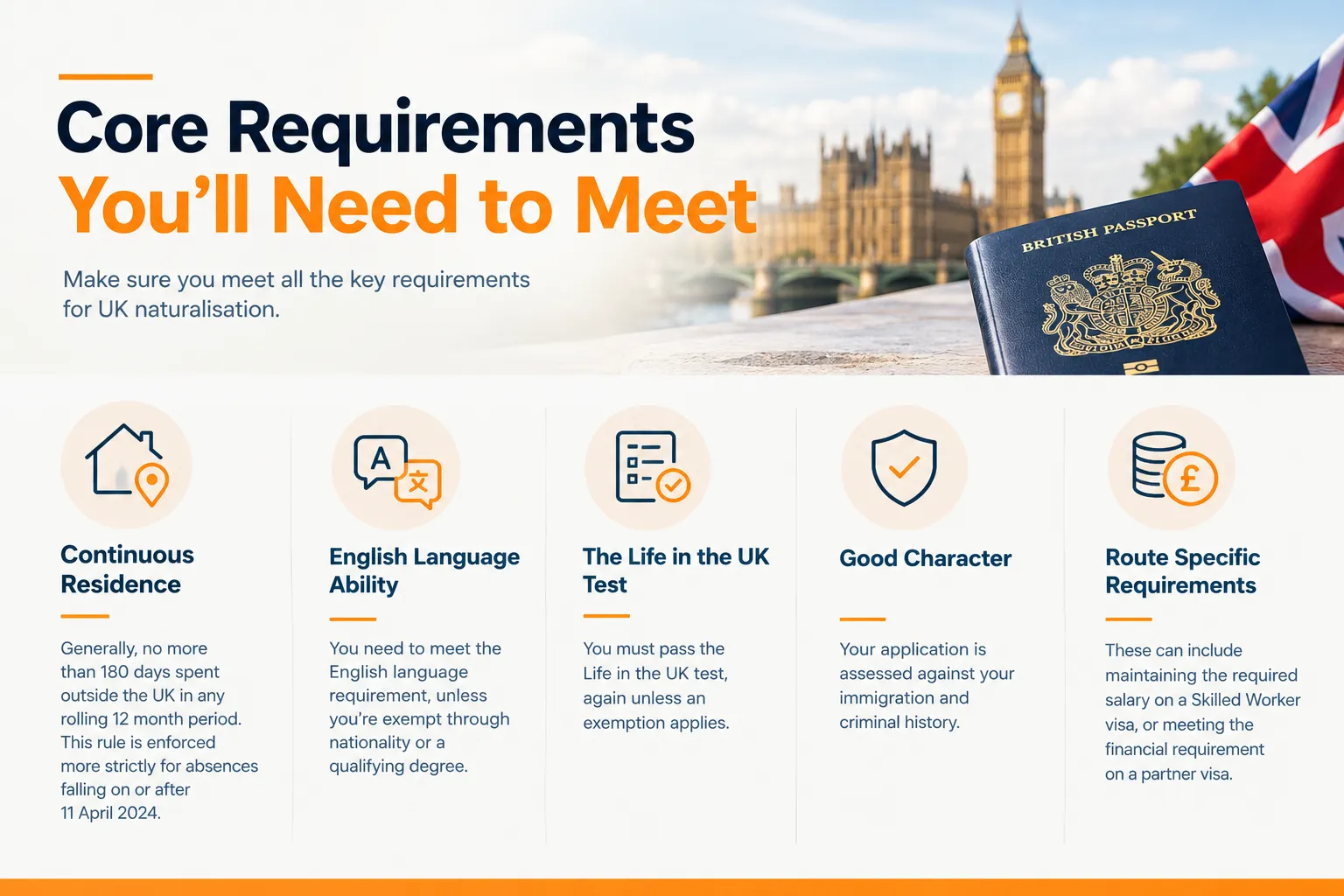
Most routes share a common set of underlying requirements, alongside whatever is specific to your visa category.
- Continuous residence, generally meaning no more than 180 days spent outside the UK in any rolling 12-month period.
- English language ability, unless you are exempt through nationality or a qualifying degree.
- The Life in the UK Test, unless an exemption applies.
- Good character, assessed against your immigration and criminal history.
- Route-specific requirements, such as maintaining the required salary on a Skilled Worker visa or meeting the financial requirement on a partner visa.
Dependants can generally apply for ILR alongside the main applicant, though they need to meet their own eligibility requirements rather than qualifying automatically through the main applicant's case.
What's Different If You're an EU, EEA or Swiss Citizen?
If this applies to you, your route runs through the EU Settlement Scheme rather than the standard Immigration Rules most other nationalities use. Settled Status under the scheme is the practical equivalent of ILR, removing time restrictions on your stay once granted.
Close family members who do not already live in the UK may first need an EU Settlement Scheme family permit. That is a separate stage before settled status becomes relevant.
A Proposed Change Worth Knowing About
There is an active, publicly discussed proposal to extend the standard qualifying period for ILR from five to ten years across most routes, with partners of British citizens expected to remain on the existing five-year timeline.
This remains a proposal under consultation, not a change currently in force. If you are planning your timeline toward settlement, keep an eye on official updates rather than assuming either outcome. Our guide to the proposed UK ILR changes explains the possible routes and transitional arrangements in more detail.
Final Words
Getting permanent residence in the UK, in practical terms, means reaching ILR through whichever route matches your circumstances: typically after five years, sometimes three, and occasionally ten under the Long Residence route. EU, EEA and Swiss citizens follow a separate but broadly equivalent path through Settled Status instead.
Once you know which route applies to you, the requirements are generally consistent and well documented, provided you plan your continuous residence carefully. If you need advice, speak with the Indefinite Leave to Remain team or arrange a consultation.
FAQs
Is permanent residence the same as Indefinite Leave to Remain?
In practical terms, yes, for most people today. Permanent Residence was a specific EU law status that stopped being issued after Brexit, and ILR is now the UK's main equivalent for removing time restrictions on someone's stay.
How many years do I need to live in the UK to get permanent residence?
Most routes require five years of continuous lawful residence, though some, such as Innovator Founder, allow this after three years and the Long Residence route requires ten years.
Do EU citizens still apply for permanent residence the same way?
No. EU, EEA and Swiss citizens generally apply through the EU Settlement Scheme for Settled Status, a separate but broadly equivalent route to Indefinite Leave to Remain.
Can my family get permanent residence too?
Yes. Dependants can generally apply for Indefinite Leave to Remain alongside the main applicant, though each person needs to meet their own eligibility requirements.
Is the five-year qualifying period for ILR going to change?
There is a proposal to extend it to ten years for most routes, excluding partners of British citizens, but this remains under consultation and is not yet in force.