
WHAT YOU NEED TO KNOW
- On 2 November 2026, the Home Secretary confirmed a new earned settlement framework, raising the standard Indefinite Leave to Remain qualifying period from 5 to 10 years for most routes.
- Partners of British citizens keep the existing 5 year route to ILR, explicitly protected under the new framework.
- Partners of someone who is settled but not a British citizen will move to a longer qualifying path instead.
- These changes are expected to apply retrospectively to anyone who does not yet hold ILR, not just new applicants.
- Rules are expected from December 2026, taking effect during 2027, so nothing has changed in practice yet.
If you are on a UK spouse visa and have seen headlines about settlement rules doubling from 5 to 10 years, the answer depends on whether your sponsor is a British citizen or someone settled in the UK without British citizenship. Partners of British citizens keep the current 5 year route to Indefinite Leave to Remain. Partners of someone settled but not British face a longer path under the new earned settlement framework.
This guide explains what was announced, why your sponsor's exact status matters and what is worth doing while these changes work their way through Parliament.
What Was Announced, and When?
On 2 November 2026, Home Secretary Shabana Mahmood confirmed in the House of Commons that the government is moving ahead with an earned settlement system, raising the standard Indefinite Leave to Remain qualifying period from 5 to 10 years for most routes.
This builds on proposals first set out in the 2025 Immigration White Paper, but the November 2026 announcement marks a step forward from consultation toward actual policy. Under the new model, settlement may depend on earnings, employment history and immigration compliance as well as time spent in the UK.
The Key Question: Is Your Sponsor British, or Just Settled?
This distinction determines which path may apply to you.
If you hold a UK spouse visa and your partner is a British citizen, the 5 year route to ILR remains protected under the new framework. Our guide on what a UK spouse visa is sets out the basics of this route.
If your partner holds Indefinite Leave to Remain or Settled Status but is not a British citizen, you are likely to face the longer qualifying path instead. Check your sponsor's exact immigration status carefully.
If you are approaching the extension stage, our guide on the spouse visa extension after 2.5 years covers that stage under the current rules.
What Is Changing for Other Routes?
- The standard qualifying period rises from 5 to 10 years for most other routes.
- A 15 year path is proposed for lower-skilled workers in roles below RQF Level 6.
- A 20 year path applies to people with immigration breaches, illegal entry or certain visa-switching histories.
- Reliance on public funds adds between 5 and 10 years, depending on how long that reliance lasted.
- The existing 10 year Long Residence route is expected to close entirely under the new framework.
- Applications are expected to be decided under the rules in force on the decision date.
Is This Law Yet?
No, not yet. This remains a confirmed policy direction rather than a change already reflected in the Immigration Rules. Rules are expected to be published from December 2026, with implementation expected during 2027. Until new rules are laid before Parliament and take effect, the current 5 year route continues to apply to spouse visa holders exactly as it does today.
What Spouse Visa Holders Should Do Right Now
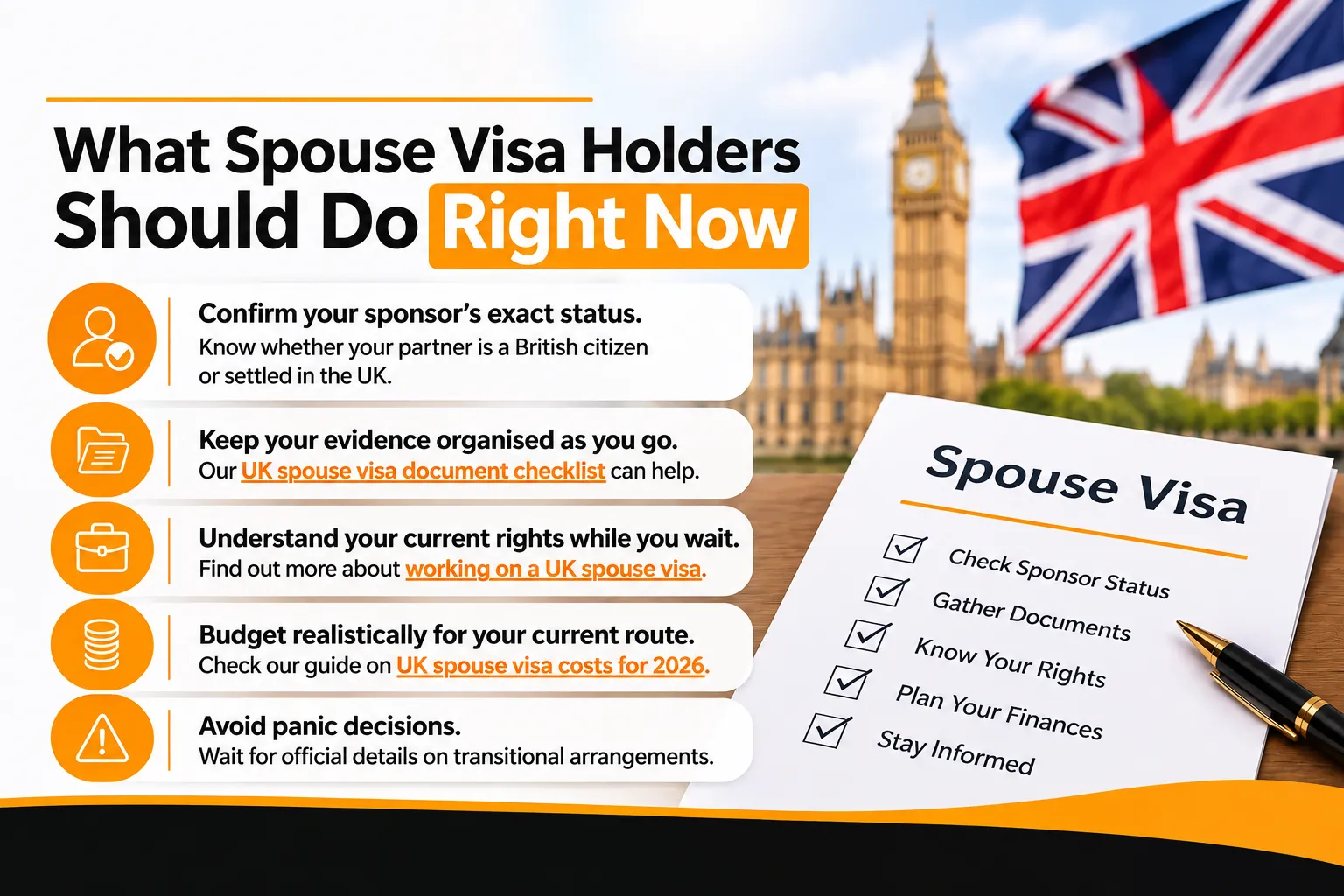
- Confirm your sponsor's exact status. Establish whether your partner is a British citizen or settled without British citizenship.
- Keep your evidence organised. Our UK spouse visa document checklist sets out what to keep on top of.
- Understand your current rights. Nothing about the announcement changes your right to work on a spouse visa right now. See our guide on working on a UK spouse visa.
- Budget realistically. Our full breakdown of UK spouse visa costs remains accurate under the current rules.
- Avoid panic decisions. Transitional arrangements have not been published, so wait for clarity before making major decisions.
Final Words
The new earned settlement framework is a significant shift in UK immigration policy, but the headline “5 to 10 years” figure does not automatically apply to every spouse visa holder. If your partner is a British citizen, the current 5 year route remains protected. If they are settled but not British, a longer path is likely coming, though transitional arrangements have not yet been published.
Westbury Law's team in Birmingham and Bristol is following these changes closely and can talk through what they mean for your situation. Get in touch with our spouse visa team to find out where you stand.
FAQs
Will the new 10 year settlement rule apply to spouse visa holders?
Not if your sponsor is a British citizen, in which case the 5 year route remains protected. If your sponsor is settled but not a British citizen, a longer path is likely to apply instead.
When will the new UK settlement rules take effect?
Rules are expected to be published from December 2026, with implementation expected during 2027. As of now, the current rules remain in force.
Will the changes apply to people already on a spouse visa?
The government has signalled these changes may apply retrospectively to anyone who does not yet hold ILR, though transitional arrangements for people already partway through their route have not been confirmed.
Does holding Settled Status count the same as being a British citizen for this purpose?
No. The protected 5 year route applies specifically to partners of British citizens, not partners of someone who holds Settled Status or Indefinite Leave to Remain without British citizenship.
Should I apply for British citizenship for my partner now to protect my settlement route?
This is a case-specific question. Naturalisation takes time and carries its own requirements, so discuss your timeline and options with an adviser rather than assuming it is a quick fix.