
Fiancé Visa vs Spouse Visa UK: Which Is Better?
Compare the UK Fiancé Visa and Spouse Visa, including eligibility, costs, work rights, visa duration and settlement. Find the right route for you.
Fiancé Visa vs Spouse Visa UK: Which Is Better for Your Situation?
Choosing between a UK Fiancé Visa and a Spouse Visa depends mainly on whether you are already married and where you plan to get married. Both routes allow eligible partners to build their lives together in the UK, but they have different conditions, costs and immigration benefits.
A Fiancé Visa allows you to come to the UK to marry your partner, while a Spouse Visa is for couples who are already legally married or in a recognised civil partnership. Understanding the differences can help you choose the right route and avoid unnecessary applications.
In this guide, we compare the UK Fiancé Visa vs Spouse Visa, including eligibility, fees, work rights, duration and the route to indefinite leave to remain (ILR).
What is the Difference Between a UK Fiancé Visa and Spouse Visa?
The main difference is your relationship status when you apply.
A UK Fiancé Visa is designed for someone who is engaged to a British citizen or another eligible UK sponsor and intends to marry or enter a civil partnership in the UK within six months of arriving.
A UK Spouse Visa is for someone who is already legally married to, or in a recognised civil partnership with, an eligible person in the UK. It allows the applicant to join their partner and live together in the country.
Both applications generally fall under the UK family visa partner route. Applicants must meet the relevant relationship, financial, accommodation and English language requirements.
Fiancé Visa vs Spouse Visa: Key Differences Compared
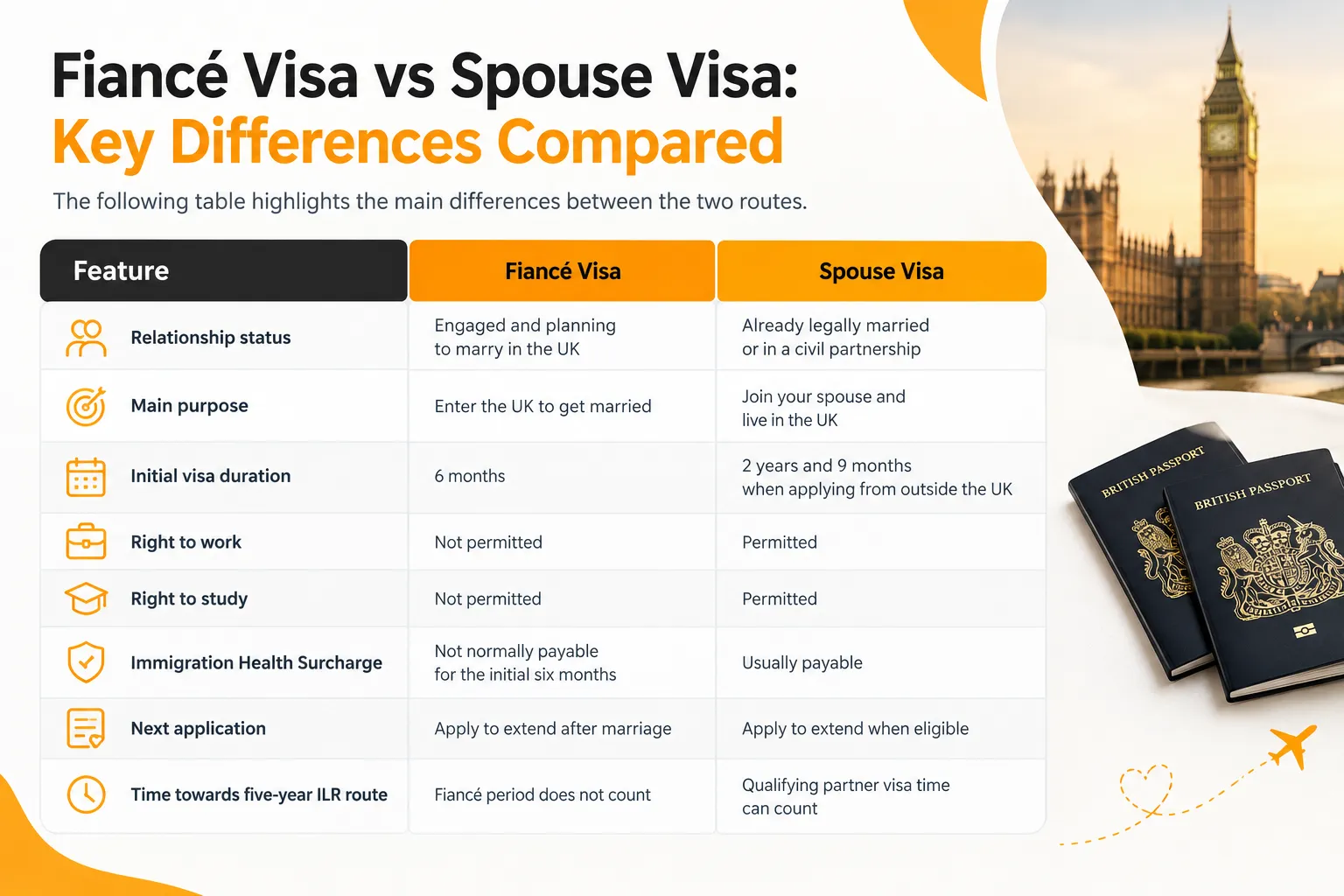
The following table highlights the main differences between the two routes.
| Feature | Fiancé Visa | Spouse Visa |
|---|---|---|
| Relationship status | Engaged and planning to marry in the UK | Already legally married or in a civil partnership |
| Main purpose | Enter the UK to get married | Join your spouse and live in the UK |
| Initial visa duration | 6 months | 2 years and 9 months when applying from outside the UK |
| Right to work | Not permitted | Permitted |
| Right to study | Not permitted | Permitted |
| Immigration Health Surcharge | Not normally payable for the initial six months | Usually payable |
| Next application | Apply to extend after marriage | Apply to extend when eligible |
| Time towards five-year ILR route | Fiancé period does not count | Qualifying partner visa time can count |
The most important practical difference is that a fiancé cannot work or study during the initial six-month period. A spouse visa holder can generally work and study once their visa has been granted.
UK Fiancé Visa: When is It the Better Option?
A Fiancé Visa may be the better option if you and your partner want to get married in the UK but have not yet legally married.
It allows an eligible applicant to enter the country for six months to marry or enter a civil partnership with their UK-based partner.
To qualify, you generally need to demonstrate that:
- You and your partner are both at least 18 years old.
- You have met in person and have a genuine relationship.
- You intend to marry or enter a civil partnership within six months of arriving.
- Any previous marriages or civil partnerships have legally ended.
- You intend to live together permanently in the UK after marriage.
- You meet the applicable financial and English language requirements.
The main advantage is that you do not need to marry before travelling to the UK. You can complete your wedding plans and marry after arriving.
However, there are important restrictions. You cannot work or study while holding the initial Fiancé Visa. After getting married, you must submit a separate application to extend your stay under the partner route.
For a detailed explanation of eligibility and the application process, read our guide on how to apply for a UK Fiancé Visa.
UK Spouse Visa: When is It the Better Option?
A UK Spouse Visa is generally the appropriate route if you and your partner are already legally married or in a recognised civil partnership.
Instead of travelling to the UK to get married, you apply to join your spouse and establish your home together.
Applicants usually need to show that:
- The marriage or civil partnership is legally recognised in the UK.
- The relationship is genuine and ongoing.
- Both partners intend to live together permanently in the UK.
- The financial and English language requirements are met.
- Suitable accommodation is available.
One major advantage of the spouse route is that you can generally work and study in the UK once your application is approved. You do not need to complete a separate fiancé-to-spouse application after arriving.
An initial Spouse Visa granted through an overseas application normally allows you to stay for two years and nine months. You can then apply for an extension if you continue to meet the requirements.
If you are already married and meet the eligibility conditions, applying directly for a Spouse Visa may be more straightforward than entering the UK on a Fiancé Visa first.
Which Visa is Cheaper: Fiancé Visa or Spouse Visa?
The total cost is an important consideration when deciding between a Fiancé Visa and Spouse Visa.
Although the initial Fiancé Visa application does not normally require an Immigration Health Surcharge, you will need to make another application after marriage. This means the overall cost can be higher.
The following are the published standard fees as of November 2026:
| Expense | Fiancé Visa route | Spouse Visa from outside UK |
|---|---|---|
| Initial application fee | £2,064 | £2,064 |
| Further application after marriage | £1,407 | Not required immediately |
| Immigration Health Surcharge | Not normally payable initially | £3,105 |
| Initial route total | £4,471 before IHS on the later application | £5,169 |
The Fiancé Visa route also requires the Immigration Health Surcharge when applying to switch to the partner route after marriage. For a standard adult application covering two years and six months, the current surcharge is £2,587.50.
Therefore, the illustrative total for the fiancé route is £7,058.50, compared with £5,169 for a standard overseas spouse application. These figures exclude legal fees, wedding expenses and any optional priority service.
Actual costs depend on your circumstances and the fees in force when you apply. Check the latest official charges before submitting an application.
For a more detailed breakdown, see our guide to fiancé visa lawyer costs and UK spouse visa costs.
Can You Switch from a Fiancé Visa to a Spouse Visa in the UK?
Yes. If you enter the UK on a Fiancé Visa and marry your partner within the permitted six-month period, you can apply to extend your stay under the partner route without leaving the UK.
You will need to submit a new application and provide evidence that you continue to meet the relevant requirements. This may include your marriage certificate, financial evidence, accommodation details and other supporting documents.
You should apply before your current permission expires and allow enough time to prepare your application.
Once your spouse or partner application is approved, you will generally be allowed to work and study in the UK.
Which Visa is Better for Your Circumstances?
There is no single answer to the question, “which is better, a Fiancé Visa or Spouse Visa?” The right choice depends on your relationship status, wedding plans and long-term priorities.
A Fiancé Visa may be suitable if:
- You are engaged but not legally married.
- You want to hold your wedding in the UK.
- You can manage the six-month period without working or studying.
- You understand that a further application will be required after marriage.
A Spouse Visa may be suitable if:
- You are already legally married or in a recognised civil partnership.
- You want to join your partner in the UK.
- You need the ability to work or study after arrival.
- You want to avoid making a separate application after a UK wedding.
If you are already married, applying directly for a Spouse Visa will generally avoid the additional fiancé application stage. However, if your intention is to marry in the UK, the Fiancé Visa is usually the relevant family visa route.
It is also important not to confuse a Fiancé Visa with a Marriage Visitor Visa. A Marriage Visitor Visa is intended for people who want to marry in the UK but do not intend to settle there through that route. It does not provide a route to switch to a Spouse Visa from within the UK.
Get Advice on Choosing the Right UK Visa Route
Choosing between a Fiancé Visa and a Spouse Visa can affect your application costs, work rights and long-term settlement plans. It is important to understand the requirements before making a decision.
Westbury Law provides UK immigration advice to couples planning to live together in the UK. Our team can assess your circumstances, explain the available routes and help you prepare the appropriate application.
Need Guidance on Your Partner or Fiancé Visa?
Our immigration solicitors assess your eligibility, calculate exact Home Office fees, and guide you through every stage of your partner application.
Arrange a Consultation with Westbury Law (£60/hr)Frequently Asked Questions
Which is better: a Fiancé Visa or a Spouse Visa?
There is no universal answer. A Spouse Visa is generally better if you are already married or prefer to marry overseas because it allows the applicant to work and study immediately and counts towards the 5-year Indefinite Leave to Remain (ILR) route. A Fiancé Visa is better if you want to marry or register a civil partnership inside the UK.
Can you work on a UK Fiancé Visa?
No. A Fiancé Visa strictly prohibits employment and study during the initial six-month period. Once you marry in the UK and successfully switch to a Spouse Visa (partner route), you gain full work and study rights.
Which visa route is cheaper overall: Fiancé Visa or Spouse Visa?
Applying directly for a Spouse Visa from overseas is cheaper overall (approximately £5,169 including application fee and initial Immigration Health Surcharge). The Fiancé Visa route requires two consecutive applications (initial fiancé application plus extension as a spouse), resulting in an illustrative total of £7,058.50 in Home Office charges and surcharges.
Can you switch from a Fiancé Visa to a Spouse Visa from inside the UK?
Yes. Once you legally marry or enter a civil partnership in the UK within the six-month visa validity, you can apply for leave to remain as a partner from within the UK without leaving the country.
Does the 6-month Fiancé Visa period count towards the 5-year settlement (ILR) route?
No. The initial six months spent on a Fiancé Visa do not count towards the five-year qualifying residency period for Indefinite Leave to Remain (ILR). The 5-year clock starts only after your Spouse Visa is granted.
Can I enter on a Marriage Visitor Visa and switch to a Spouse Visa in the UK?
No. A Marriage Visitor Visa is strictly for couples who want to marry in the UK and leave before the visa expires. You cannot switch from a Marriage Visitor Visa to a Spouse Visa or any other settlement route from inside the UK.